Mini Splits for ADUs and DADUs in Seattle: What Homeowners Need to Know
Building an ADU or DADU in Seattle? See what a ductless mini split costs, how the 2021 energy code treats it, how to size it, and which rebates apply in 2026.
Heating and cooling a Seattle backyard cottage
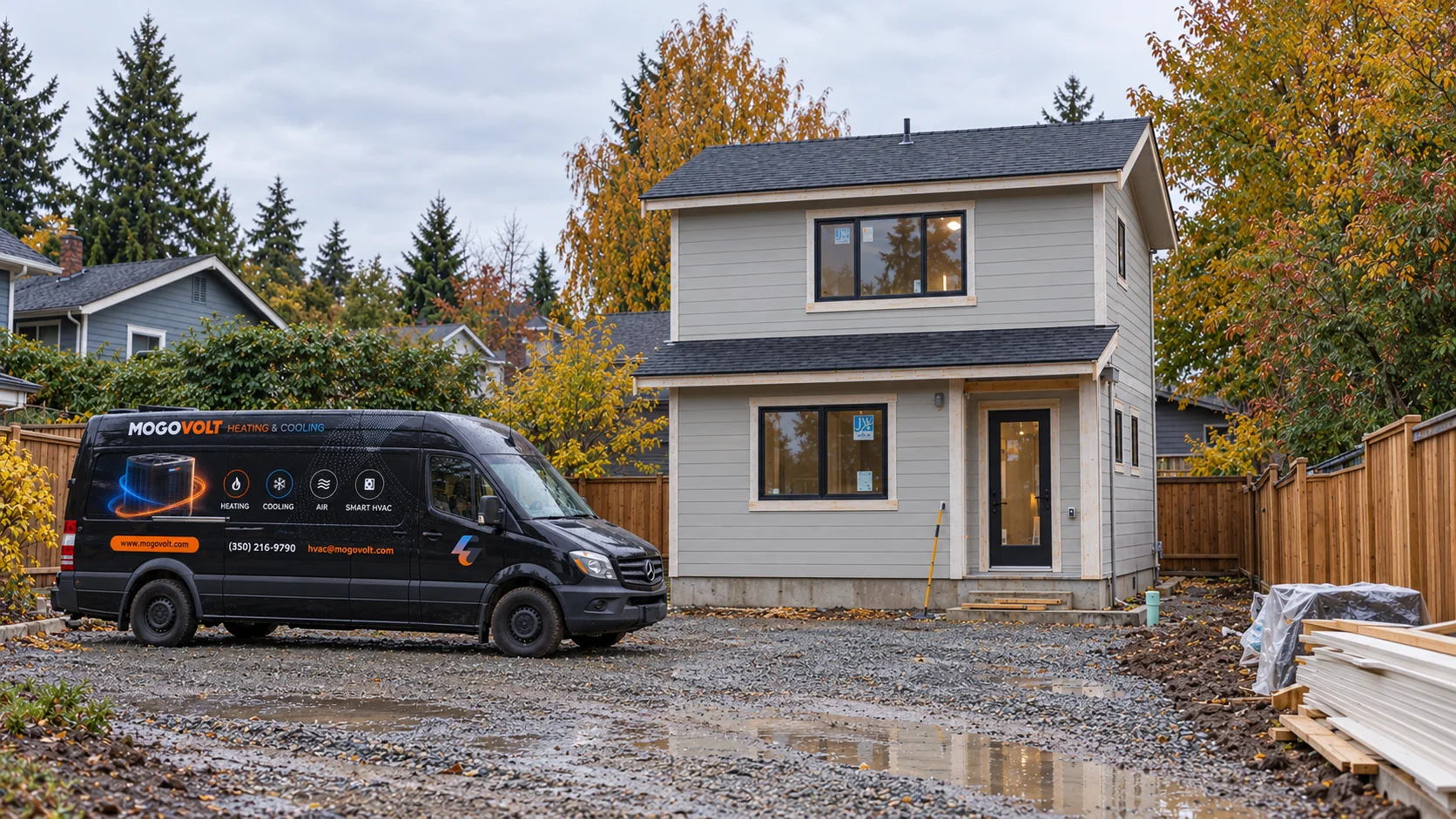
A ductless mini split is the right heating and cooling system for almost every ADU or DADU built in Seattle today. It is the system the Washington energy code rewards, it fits a 400 to 1,000 square foot unit without ducts eating into the floor plan, and it gives the unit its own thermostat, its own bill, and air conditioning for the summers that now hit the 90s.
Seattle lets you build up to two ADUs on a lot, and a detached unit (DADU) can be up to 1,000 square feet of gross floor area (SDCI ADU rules). That size is exactly where a single-zone or small multi-zone mini split does its best work. This guide covers why a mini split beats the alternatives, what the energy code requires for a new ADU, how to size the system, what it costs installed in Seattle, which rebates still apply in 2026, and the installation details that trip up backyard cottage projects.
Use our savings calculator to compare estimated heating costs while planning your ADU.
Why a mini split beats the other ADU heating options
There are really only four ways to heat a Seattle ADU, and three of them have a serious drawback.
| Option | Upfront cost | Operating cost | Cooling? | The catch |
|---|---|---|---|---|
| Ductless mini split heat pump | Moderate | Lowest (heat pump efficiency) | Yes | Needs a 240V circuit and an outdoor unit location |
| Electric baseboard or wall heaters | Lowest | Highest (resistance heat) | No | Burns energy-code credits you then have to make up with envelope upgrades; tenants complain about bills |
| Extending the main house furnace or heat pump | Varies | Shared with main house | Only if the house has AC | Shared thermostat, shared bill, long duct runs; usually not allowed for a separately metered DADU |
| Ducted mini split (slim-duct air handler) | Highest | Low | Yes | Needs a soffit or attic for the air handler and ducts; worth it in a 3-room unit |
Independent comfort and utility costs
Baseboards look cheap and cost the most. Electric resistance heat makes one unit of heat per unit of electricity. A mini split heat pump moves two to four units of heat per unit of electricity in Seattle's mild winters. Seattle City Light puts the savings at 25 to 50 percent lower heating costs compared to standard electric heat (Seattle City Light). On a rental, the tenant pays that difference, and lower utility bills are a selling point in the listing.
Tying into the main house rarely works. A DADU is a separate building with its own envelope and often its own meter. Running ducts across a yard is not practical, and sharing a thermostat between a landlord and a tenant creates problems nobody wants. For an attached ADU (basement or garage conversion), extending the existing system sometimes pencils out, but you lose independent control and the ability to bill the unit separately.
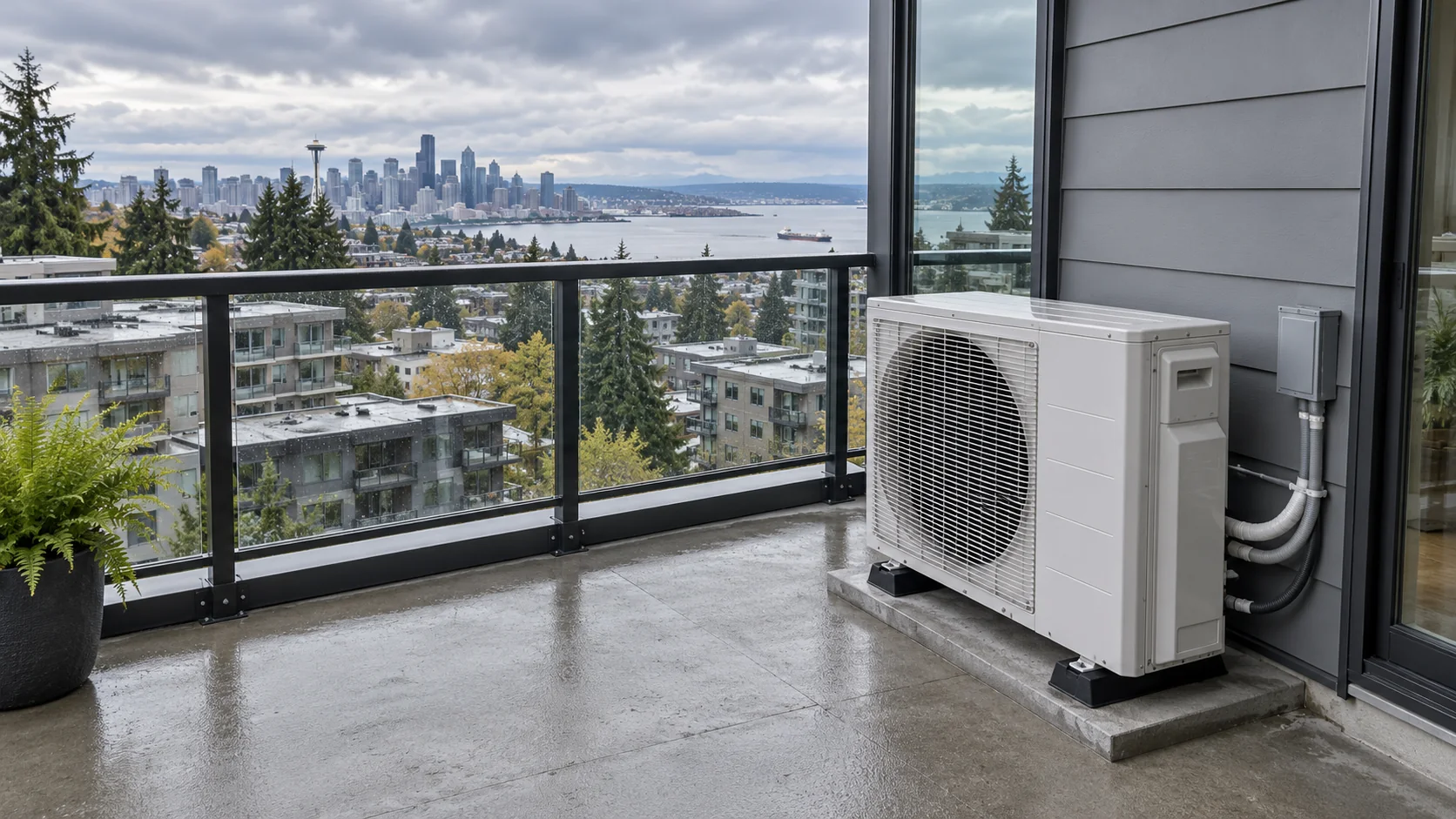
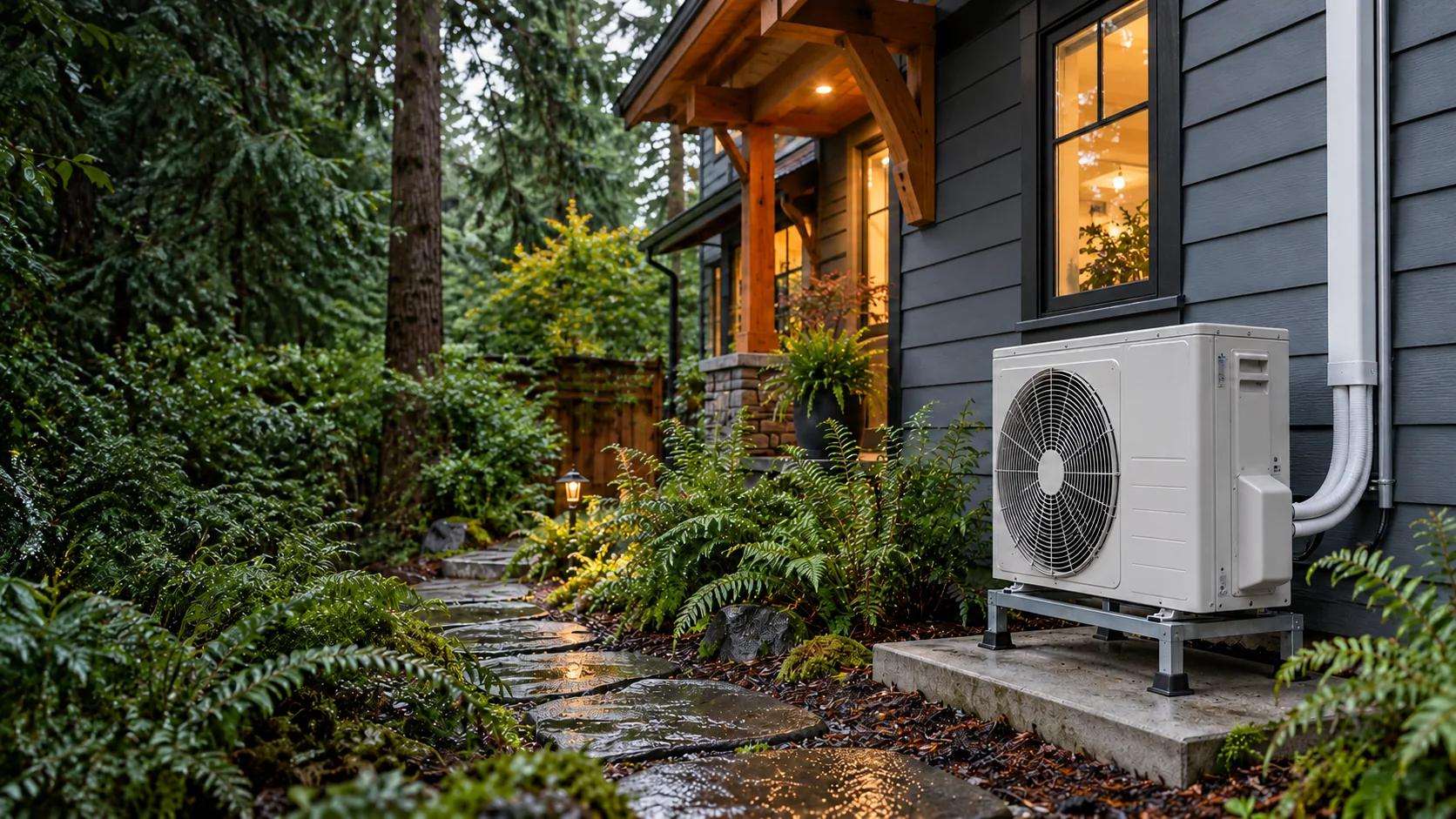
A mini split gives the ADU its own system. One outdoor unit on the wall, one or two indoor heads, a dedicated circuit, and the unit heats and cools itself. If the ADU is on its own Seattle City Light meter, the occupant pays for exactly what they use.
What the Seattle energy code requires for a new ADU
A new ADU or DADU in Seattle must meet the 2021 Washington State Energy Code, and that code pushes hard toward heat pumps. The original 2021 code tried to mandate heat pumps outright; that mandate was pulled back over a federal preemption question, and the state replaced it with a credit system that still steers nearly every new unit to a heat pump (Washington State Standard).
Here is how the credits work for an ADU, per the WSU Energy Program's guide to Section R406 (WSU Energy Program):
- A small dwelling unit needs 5.0 credits. "Small" means under 1,500 square feet of conditioned floor area with under 300 square feet of windows and glass doors. Nearly every ADU qualifies, as long as the designer keeps glazing under 300 square feet. Go over on glass and the unit jumps to the medium tier at 8.0 credits.
- A ductless heat pump with no electric resistance backup earns 2.0 credits (option 3.7). The system must have an HSPF2 of 9.0 or better and be sized to heat the whole unit at the outdoor design temperature. For units with a heating load of 24,000 BTU or less using a multi-zone system rated 24,000 or less, the bar drops to HSPF2 8.19.
- A ductless head in the largest zone with baseboards elsewhere earns 1.5 credits (option 3.5). This is the compromise path, and it is where many ADU plans land when bedrooms get baseboards.
- The rest comes from the envelope, air sealing, water heating, and appliances. A heat pump water heater (option 5.6) adds 2.0 credits. Tight construction with heat recovery ventilation adds 1.0 to 2.0. Pair a mini split with a heat pump water heater and a reasonably tight envelope and the 5.0 credits are easy.
Plan the equipment before permit submittal
Two practical notes. First, the energy credit selections and the heating equipment efficiency go on the permit drawings, so the HVAC decision needs to be made before the SDCI submittal, not after framing. Second, the code requires a heating load calculation for equipment sizing, which rules out guessing by square footage. More on that below.
Seattle adopted the 2021 state code with minor local amendments; for residential work the city's requirements largely match the state's (SDCI).
Sizing a mini split for a Seattle ADU
Most Seattle ADUs need between 9,000 and 18,000 BTU of heating capacity, and the biggest sizing mistake is going too large. New construction built to the 2021 code is tight and well insulated, so the loads are far lower than the old 20-to-25-BTU-per-square-foot rule of thumb suggests. An oversized mini split short-cycles, dehumidifies poorly in summer, and wears out faster.
Typical ranges for a code-built Seattle ADU (approximate; a load calculation decides the final number):
| ADU size | Typical heating load | Common equipment |
|---|---|---|
| 300–500 sq ft studio | 6,000–9,000 BTU | One 9,000 BTU single-zone head |
| 500–750 sq ft one-bedroom | 8,000–12,000 BTU | One 12,000 BTU head, or a 2-zone (9k + 6k) if the bedroom door stays shut |
| 750–1,000 sq ft two-bedroom | 10,000–18,000 BTU | 2- or 3-zone system, or a ducted mini split with one slim air handler |
Three things move the number
- Glazing. A DADU with a wall of south-facing sliders has a much higher cooling load than one with modest windows. This also matters for the energy credits (keep it under 300 square feet).
- Layout. A mini split head heats the room it is in. An open studio is easy. A one-bedroom with the door closed at night needs either a second head, a ducted unit, or a small transfer fan.
- Design temperature. Seattle's winter design temperature is in the mid-20s °F, which is mild. The code's heat-pump credits require the system to carry the full load at that temperature with no electric backup, so the equipment's rated capacity at low ambient (not just the nominal number on the box) is what counts.
Use a room-by-room load calculation
The Washington energy code requires equipment to be sized from an ACCA Manual J load calculation, and SDCI can ask to see it. Any contractor who quotes a size from square footage alone is guessing. Mogovolt runs a room-by-room load calculation on every ADU before we quote equipment.
Single-zone, multi-zone, or ducted: which mini split fits your ADU
For a studio or open one-bedroom, a single-zone wall-mounted head is the best value and the most efficient option. For a two-bedroom DADU, the choice is between a multi-zone system and a ducted mini split, and the floor plan decides it.
Single-zone (one outdoor unit, one head). The simplest and cheapest install, and single-zone units carry the highest efficiency ratings, which makes the HSPF2 9.0 credit threshold easy to hit. Best for studios and open-plan units under about 650 square feet. Mount the head high on an interior wall so it throws air across the room, not into the kitchen cabinets.
Multi-zone (one outdoor unit, two or three heads). Each room gets its own head and its own temperature. The trade-off is that the smallest head available is usually 6,000 BTU, which is more than a 120-square-foot bedroom needs, so the bedroom head cycles a lot. Multi-zone outdoor units also carry lower efficiency ratings than single-zone, which is why the code gives a lower HSPF2 target (8.19) for small multi-zone systems. Sensible for a two-bedroom unit where bedrooms are closed at night.
Ducted mini split (one outdoor unit, one concealed air handler). A slim horizontal air handler hides in a dropped ceiling or soffit and feeds short ducts to each room. One thermostat, no wall heads, even temperatures, and good for a 1,000 square foot two-bedroom. It costs more and needs about 8 to 10 inches of ceiling cavity, which has to be planned with the architect, not added after drywall. Ducts must stay inside the conditioned envelope.
Cold-climate models are a nice-to-have, not a must. Seattle's design temperature is mild enough that standard inverter mini splits from the major brands hold their capacity fine. A cold-climate (hyper-heat) unit buys you more capacity at 5°F, which matters in Spokane, not Ballard. Spend the money on the right size and a clean install instead.
Pick inverter-driven equipment with a strong low-ambient rating. All modern mini splits are inverter-driven, but the published capacity at 17°F varies a lot between models. That figure is what the energy code sizing rule cares about.
What a mini split costs installed in a Seattle ADU
Budget roughly $4,500 to $7,500 for a single-zone mini split installed in a Seattle ADU, $9,000 to $14,000 for a two- or three-zone system, and $11,000 to $17,000 for a ducted mini split. These are typical 2026 Seattle-area ranges for new construction with a dedicated circuit already roughed in; your quote will depend on brand, line-set length, and how the outdoor unit is mounted.
| System | Typical installed cost (Seattle, 2026) | Best for |
|---|---|---|
| Single-zone, 9k–12k BTU | $4,500–$7,500 | Studios, open one-bedrooms |
| Multi-zone, 2–3 heads | $9,000–$14,000 | Two-bedroom DADUs |
| Ducted mini split | $11,000–$17,000 | Two-bedroom DADUs where wall heads are unwanted |
What adds cost
For a wider comparison of equipment and labor costs across Seattle homes, see our ductless mini split cost guide.
What adds cost: a long line-set run to hide the outdoor unit, a roof or ground-stand mount instead of a wall bracket, a condensate pump when gravity drain is not possible, and electrical work if the DADU subpanel was not sized for the heat pump.
Rebates and incentives in 2026
- Seattle City Light contractor discount: $300 to $600. When a contractor buys a qualifying heat pump through a participating distributor, City Light provides an instant discount the contractor passes through on the bid. The amount depends on efficiency: $300 at HSPF2 8.1, $400 at HSPF2 8.5, and $600 at HSPF2 9.5 with SEER2 16. DIY installs are not eligible (Seattle City Light). Ask for it by name; not every bid includes it.
- Seattle City Light heat pump water heater: $750. If the ADU gets its own heat pump water heater (which also earns 2.0 energy credits), the same contractor program offers a $750 discount.
- Federal 25C tax credit: ended. The $2,000 federal heat pump tax credit expired for equipment installed after December 31, 2025, and there is no federal replacement for 2026 installations (Home Energy Basics). Do not count on it in your ADU budget.
- Puget Sound Energy customers: if your lot is in PSE electric territory rather than City Light, PSE runs its own ductless heat pump rebates, generally for replacing existing heat rather than new construction, so check eligibility before assuming it applies.
New construction and rebate eligibility
For a retrofit in the older main house instead, see how a Seattle Craftsman can add a heat pump without ductwork.
The oil-to-heat-pump Clean Heat rebate and the income-qualified HomeWise program are for existing homes converting their heating; they do not apply to a new ADU.
Installation details that catch ADU projects off guard
The HVAC on a backyard cottage is usually a small line item, but five details cause most of the delays.
- Outdoor unit placement and setbacks. A DADU in Seattle typically sits 5 feet from side and rear lot lines, which leaves little room for the condenser. Mechanical equipment in required yards has its own rules under Seattle's land use code, and the Seattle noise code limits sound at the property line, lower at night. A modern inverter mini split runs at roughly 50 dB or less at low speed, but placement still matters: put the outdoor unit on the wall facing your own house or yard, not the neighbor's bedroom window, and keep 12 inches of clearance behind it and 24 inches in front.
- Electrical. A 9k–12k BTU single-zone needs a dedicated 240V circuit, typically 15 to 20 amps; multi-zone systems need 25 to 30 amps. The DADU subpanel (or separate City Light service) must have the capacity, and if the ADU also gets a heat pump water heater, an induction range, and an EV charger, load calculations on the feeder from the main house get tight fast. Have the electrician and HVAC contractor talk before the panel is ordered.
- Condensate. Every indoor head and air handler produces condensate in cooling mode. Gravity drain to the exterior is cleanest; a wall head on an interior wall often needs a condensate pump, which adds noise and a failure point. Decide head locations with drainage in mind.
- Line-set routing. Refrigerant lines run from each head to the outdoor unit. On a new build they can be concealed in the wall before drywall, which looks far better than exterior line-hide covers. This has to be coordinated during rough-in, so bring the HVAC contractor in at framing, not at finish.
- Permits and inspection. The mechanical permit for a mini split is usually pulled under the ADU's building permit. The energy code credit sheet, the load calculation, and the equipment efficiency ratings all go on the plans. A Seattle HVAC contractor who does ADUs regularly will supply those documents for the submittal.
Frequently asked questions
Is a mini split required for an ADU in Seattle?
Not by name, but in practice. A new ADU must earn 5.0 energy credits under the 2021 Washington State Energy Code, and a ductless heat pump with no electric backup earns 2.0 of them. Baseboard heat earns none, so a baseboard-only ADU has to make up the gap with expensive envelope and ventilation upgrades.
What size mini split does a 600 square foot ADU need?
Usually a 9,000 or 12,000 BTU single-zone unit. A code-built 600 square foot ADU in Seattle has a heating load of roughly 8,000 to 11,000 BTU. The final number comes from a Manual J load calculation, which the energy code requires.
Can a mini split heat a DADU all winter without backup heat?
Yes. Seattle's winter design temperature is in the mid-20s °F, and modern inverter mini splits keep most of their rated capacity at that temperature. The energy code's 2.0-credit option specifically requires the heat pump to carry the whole load with no electric resistance backup.
How much does it cost to put a mini split in an ADU in Seattle?
About $4,500 to $7,500 installed for a single-zone system and $9,000 to $14,000 for a two- or three-zone system in 2026. A Seattle City Light contractor discount of $300 to $600 applies to qualifying equipment.
Do I need a separate electric meter for the ADU's mini split?
No. A mini split runs fine on a subpanel fed from the main house. A separate City Light meter is a landlord decision about billing, not an HVAC requirement, though it makes passing utility costs to a tenant simpler.
Does a mini split work for a garage conversion ADU?
Yes, and it is often the only practical option, since a converted garage rarely has ducts and extending the house furnace means long runs through the wall. A single wall head on the shared wall with the line set to a condenser on the exterior is a one-day install.
Where should the outdoor unit go on a backyard cottage?
On the wall facing your own property, with clearance from the lot line, away from bedroom windows on either side. Wall brackets keep it off the ground and out of leaf litter; a small ground pad works where setbacks allow.
Get a mini split quote for your Seattle ADU
Mogovolt Heating & Cooling installs ductless and ducted mini splits in ADUs and DADUs across Seattle, from Ballard and Greenwood to Columbia City and West Seattle. We run the load calculation, supply the energy credit documentation for your SDCI permit, apply the Seattle City Light contractor discount, and coordinate line-set rough-in with your builder so nothing gets cut into finished drywall.
Start with our free savings calculator to see what a heat pump will cost to run in your unit, or contact us for a site visit and a fixed-price quote.
Mogovolt Heating & Cooling · Greater Seattle and the Eastside · (206) 963-2973. Explore our heat pump and ductless installation services.
Sources
- Seattle City Light – Home Energy Solutions (heat pump contractor discounts, HPWH rebate)
- WSU Energy Program – R406 Energy Credit Requirements and Options (2021 WSEC-R)
- SDCI – Accessory Dwelling Unit rules presentation
- SDCI – 2021 Seattle Energy Code adoption summary
- Washington State Standard – state building council heat pump rules
- Home Energy Basics – Washington heat pump incentives 2026 (federal 25C status)
Cost and sizing estimates
Installed cost ranges and BTU ranges are Mogovolt's estimates for typical 2026 Seattle-area ADU projects and should be confirmed with a site-specific quote.