Ductless Mini Split Cost in Seattle (2026)
What a ductless mini split costs in Seattle in 2026: $5,000–$9,000 single-zone, $9,000–$16,000 multi-zone, plus City Light and Clean Heat rebates that cut the bill.
How much does a ductless mini split cost in Seattle?
A ductless mini split costs $5,000 to $9,000 installed for one zone in Seattle in 2026, and $9,000 to $16,000 for a multi-zone system that heats and cools most of a house. That is before rebates. Seattle City Light's contractor discount and the City's Clean Heat oil-conversion rebate can take $300 to $6,000 off, depending on what you heat with today.
Those numbers are higher than the $2,000 to $5,000 you will see on national cost sites. Seattle labor rates, a refrigeration permit that only a licensed contractor can pull, and the cold-climate equipment that makes sense here all push the local price up. The sections below break down where the money goes, what moves your quote, and how to get the rebates applied before you pay.
Seattle mini split cost by system type (2026)
Zones drive the price more than anything else. Each indoor head adds equipment, a line set, a drain, and a half day of labor.
| System | Installed cost, Seattle 2026 | Typical home |
|---|---|---|
| Single-zone, 9k–12k BTU | $5,000–$9,000 | One room, ADU, bonus room, home office |
| Two-zone | $8,000–$12,000 | Living room + main bedroom in a 1,000–1,400 sq ft home |
| Three-zone | $11,000–$15,000 | Craftsman or bungalow, main floor plus two bedrooms |
| Four- to five-zone | $14,000–$20,000 | Whole-home replacement for baseboard or oil |
| Ducted (concealed) mini split | $11,000–$17,000 | Homeowners who do not want wall heads |
Why quotes vary within the price range
A single-zone with a short line set, a wall bracket, and an existing circuit lands near the bottom of its range. Add a long concealed line-set run, a roof mount, or a new circuit from the panel and the same unit lands near the top. These ranges are Mogovolt's estimates for 2026 Seattle work and match what contractors declared on Seattle permits over the past three years (NailThePrice permit data): a median of about $9,000, with the middle half between $5,000 and $15,000.
Where the money goes on a Seattle install
On a typical $7,000 single-zone job, the equipment is less than half the bill. Labor, electrical, and permits make up the rest, and those are the parts that vary most between contractors.
| Line item | Share of a single-zone job | What it covers |
|---|---|---|
| Equipment | $2,000–$4,000 | Outdoor unit, indoor head, line set, bracket or pad, controller |
| HVAC labor | $1,500–$3,000 | Mounting, line-set routing, vacuum and charge, drain, commissioning |
| Electrical | $500–$1,500 | Dedicated 240V circuit, disconnect, whip; more if the panel is full |
| Permits | $250–$500 | SDCI refrigeration permit plus electrical permit; the refrigeration permit can only be pulled by a licensed refrigeration contractor, not a homeowner |
| Extras | $0–$1,500 | Condensate pump, line-set cover, roof or ground stand, drywall patching, removal of old equipment |
Seattle permits and outdoor-unit noise
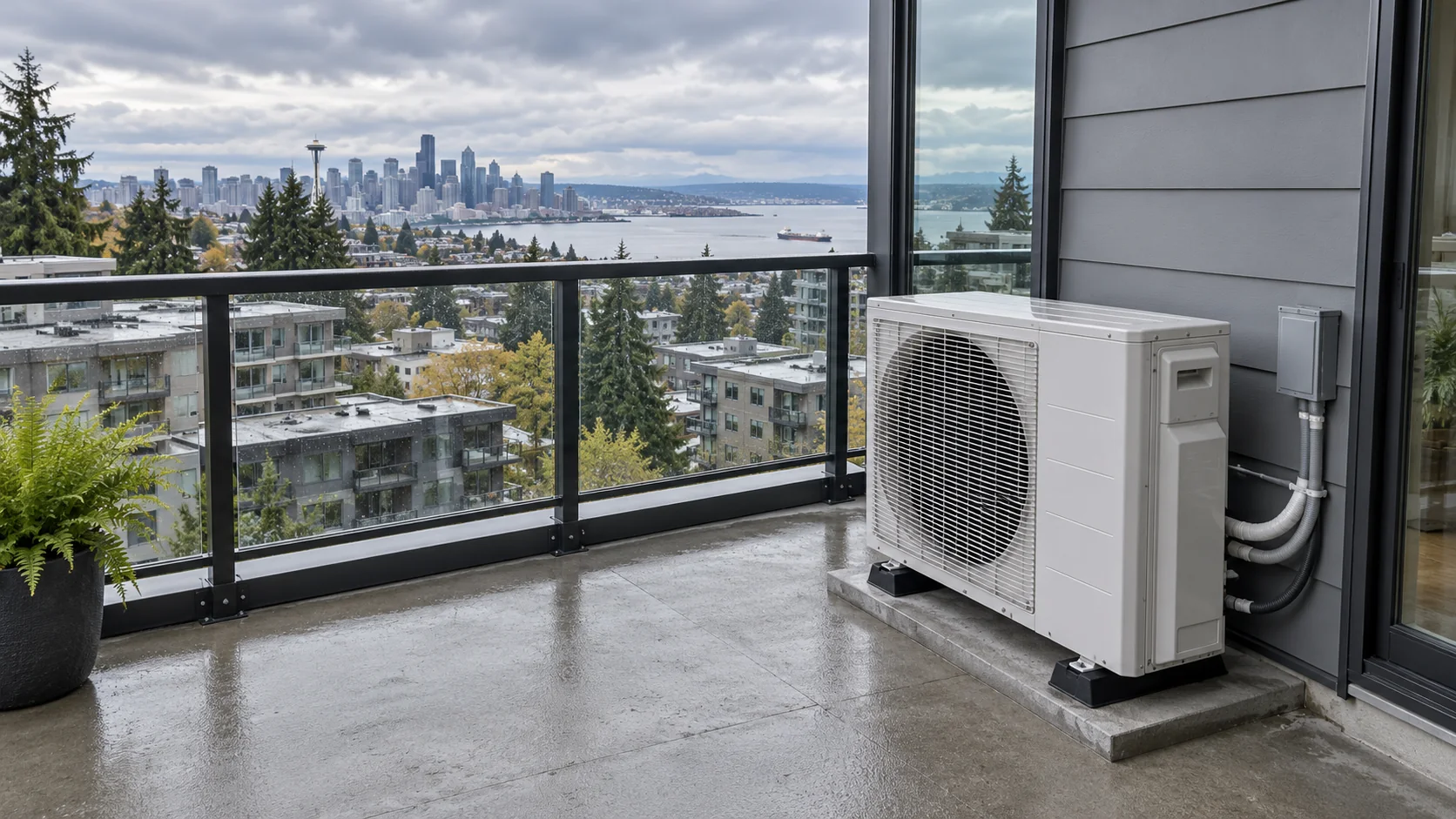
For balcony installations, shared exteriors, and HOA approvals, see our Seattle condo heat pump guide.
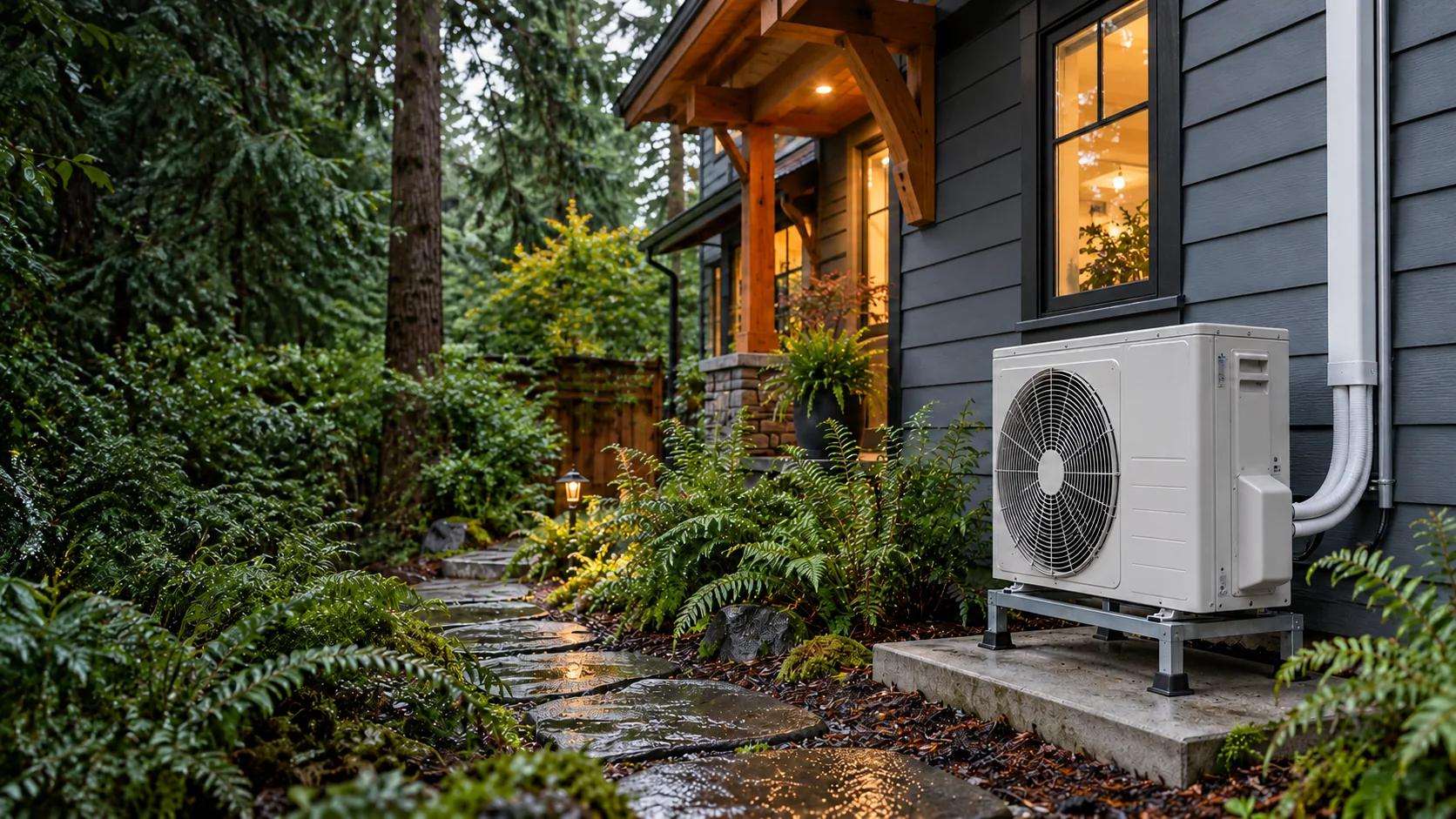
Two Seattle-specific items catch people off guard. The refrigeration permit means a DIY or handyman install is not legal here, which is also why DIY installs do not qualify for City Light rebates. And Seattle's 45-decibel noise limit at the property line matters on narrow lots: a quiet outdoor unit or a placement away from the neighbor's bedroom window may cost a little more up front and save a complaint later.
What pushes a Seattle quote up or down
- Number of zones. The biggest lever. One outdoor unit can feed up to five heads, but each head adds $1,500 to $3,000.
- Electrical panel capacity. Many Seattle homes built before 1970 still have a 100-amp panel. A mini split needs its own 15–30 amp 240V breaker. If the panel is full or undersized, a subpanel adds $800–$1,500 and a full panel upgrade adds $3,000–$5,000.
- Line-set length and routing. A head on the same wall as the outdoor unit is a 15-foot run. Routing to an upstairs bedroom through a closet or soffit is 40–60 feet and several hours of labor.
- Mounting. Wall brackets are cheapest. Ground stands need a pad. Roof mounts, common on Capitol Hill and Queen Anne rowhouses, add $500–$1,200.
- Cold-climate rating. Seattle's design temperature is in the mid-20s °F, which a standard inverter unit handles. If you want a unit rated to full capacity at 5 °F, expect $500–$1,500 more per outdoor unit. It is worth it for whole-home systems with no backup heat; it is usually not needed for a single bonus room.
- Brand tier. Mitsubishi, Daikin, and Fujitsu premium lines run 20–40% more than value brands like Gree, Senville, or MrCool. The premium buys quieter operation, longer warranties, and better low-temperature performance.
- Condensate. A head that cannot gravity-drain outside needs a condensate pump, about $200–$400 installed, and a pump is one more thing to service.
- What you are replacing. Removing an oil tank or old furnace is a separate line item, and oil tank decommissioning in Seattle runs $500–$2,500 on its own.
Seattle mini split rebates in 2026
The federal heat pump tax credit is gone, but Seattle has more local money on the table than almost any city in the country. What you qualify for depends on your utility and what you heat with now.
| Program | Amount | Who qualifies | How you get it |
|---|---|---|---|
| Seattle City Light contractor discount | $300–$600 | Any City Light customer, any existing fuel | Contractor buys through a participating distributor and passes the discount on the invoice; one outdoor unit per home |
| Seattle Clean Heat | $2,000 base, +$4,000 if under 150% AMI | Seattle homes heating with oil | Participating contractor applies it on the invoice |
| HomeWise / Office of Housing | Full cost | Income-qualified Seattle homes on oil, gas, or electric baseboard | Apply through the City; the City arranges the install |
| Washington HEAR program | Up to $8,000 for a heat pump | Households at or below 150% of area median income | Through a regional third-party administrator; income verified before install |
| PSE Efficiency Boost | Up to $4,000 | Income-qualified PSE gas customers replacing a gas furnace | Through PSE and an enrolled contractor |
| Federal 25C tax credit | $0 | — | Ended for equipment installed after December 31, 2025 |
Rebate stacking and example net prices
The programs stack. A Seattle household on oil heat that earns under 150% of AMI can combine $6,000 of Clean Heat money with the City Light discount, and HEAR on top if funds are available through their administrator. A market-rate household on oil still gets $2,300 to $2,600 off without any income paperwork.
What that does to the bill:
- Single-zone, electric baseboard home, market rate: $7,000 − $600 = $6,400
- Three-zone replacing an oil furnace, market rate: $13,000 − $2,000 − $600 = $10,400
- Three-zone replacing an oil furnace, under 150% AMI: $13,000 − $6,000 − $600 = $6,400, before HEAR
Before relying on a rebate
Two rules worth knowing: the City Light discount only goes to the contractor, so if a bid does not mention it, ask. And none of these rebates apply to a DIY install, which in Seattle is not permitted anyway.
What a mini split costs to run in Seattle
Seattle has some of the cheapest electricity in the country, roughly 13 to 14 cents per kWh on City Light's residential rate in 2026, and that is what makes the payback work. A mini split delivers about three units of heat for every unit of electricity it uses, so heating a room costs roughly a third of what the same baseboard heater costs.
Approximate annual heating cost for a 1,500 sq ft Seattle home (your usage will vary):
- Oil furnace: $2,000–$2,800 at recent heating oil prices
- Electric baseboard: $1,500–$2,200
- Gas furnace: $900–$1,300
- Ductless mini split: $500–$800
Mini split payback in Seattle
Against oil, a three-zone system pays for itself in roughly four to six years after Clean Heat rebates. Against baseboard, a single-zone in the main living space usually pays back in five to eight years, faster if you also use it for cooling in summer. Against a working gas furnace the savings are modest, so the case for a mini split on a gas home is usually about adding air conditioning, not heating savings.
Run your own numbers with our heat pump savings calculator using your actual bills.
Mini split vs. central heat pump vs. furnace and AC
If your home already has ducts in good shape, a central heat pump is usually the cheaper way to heat and cool the whole house. If it does not, a mini split wins, because adding ductwork to a finished Seattle home costs $6,000 to $12,000 by itself.
| Option | Installed cost, Seattle 2026 | Best fit |
|---|---|---|
| Ductless mini split, 3–4 zones | $11,000–$18,000 | No ducts; Craftsman, bungalow, rowhouse, baseboard or oil home |
| Central ducted heat pump | $9,000–$16,000 | Existing ducts in good shape; replaces a furnace and adds AC in one unit |
| Gas furnace + central AC | $10,000–$17,000 | Existing ducts and gas service; no rebates in Seattle |
| Add ductwork + central heat pump | $16,000–$28,000 | Rarely worth it on a finished home |
Keeping an existing furnace
Seattle's rebates only pay for heat pumps, so a furnace-and-AC combo starts a few thousand dollars behind before you count operating cost. Many Seattle homeowners with an older gas furnace and no AC end up with a hybrid: keep the furnace for now and add a single- or two-zone mini split for cooling and shoulder-season heat.
How to get an accurate quote and avoid overpaying
A good Seattle mini split bid is itemized, sized from a load calculation, and shows the rebates. If a quote is a single number on a business card, get another one.
A complete bid should list:
- Equipment by model number, with its HSPF2 and SEER2 ratings (the City Light discount tiers depend on them)
- Number of zones, BTU per head, and the room each serves
- Line-set length and routing, and whether it is concealed or in a cover
- Electrical scope: new circuit, disconnect, and any panel work, with the electrical permit included
- SDCI refrigeration permit and inspection
- Rebates applied, by name and amount
- Removal of old equipment, and oil tank decommissioning if that applies
- Labor warranty separate from the manufacturer's parts and compressor warranty
Red flags in a mini split bid
- Sizing by square footage alone. Seattle homes vary too much in insulation and glass for a rule of thumb; ask for a Manual J or an equivalent load calc.
- One head per bedroom by default. A 90 sq ft bedroom does not need a 9,000 BTU head, and oversized heads short-cycle and dehumidify poorly. A small ducted cassette serving two or three bedrooms is often the better design.
- No permit, or "we can skip the permit to save you money." An unpermitted install voids the rebate, can complicate a home sale, and the refrigeration permit is required by the City.
- The rebate is "included" but not shown as a line item.
Compare the full scope
Get three bids, but compare the scope, not just the total. The cheapest bid often leaves out the electrical, the permit, or the line-set cover, and those show up later as change orders.
Frequently asked questions
How much does a single-zone mini split cost in Seattle?
About $5,000 to $9,000 installed in 2026, including the SDCI permit and a dedicated electrical circuit. A short line set and an existing circuit put you near $5,000; a long concealed run or panel work pushes toward $9,000.
How much does a multi-zone mini split cost in Seattle?
Two zones run $8,000 to $12,000, three zones $11,000 to $15,000, and a four- or five-zone whole-home system $14,000 to $20,000. Each added head costs roughly $1,500 to $3,000.
Are there mini split rebates in Seattle in 2026?
Yes. Seattle City Light gives contractors a $300 to $600 discount on qualifying heat pumps that is passed on to you. Homes converting from oil get a $2,000 Clean Heat rebate, or $6,000 if household income is under 150% of area median. Income-qualified households may also get up to $8,000 through Washington's HEAR program. The federal tax credit ended after 2025.
Do I need a permit for a mini split in Seattle?
Yes. Seattle requires a refrigeration permit for any split-system heat pump, and only a licensed refrigeration contractor can pull it. The electrical circuit needs its own permit. Together they add about $250 to $500.
Can I install a mini split myself to save money in Seattle?
Not legally. The refrigeration permit cannot be issued to a homeowner, and DIY installs are excluded from every Seattle rebate. The $600 to $6,000 in rebates you give up usually exceeds the labor you would save.
Is a mini split cheaper than a central heat pump?
For a home that already has good ducts, a central heat pump is usually $2,000 to $4,000 cheaper for the whole house. For a home without ducts, a mini split is cheaper by the cost of the ductwork, typically $6,000 to $12,000.
How much does it cost to run a mini split in Seattle?
Roughly $500 to $800 a year to heat a 1,500 sq ft home at City Light rates, compared with $1,500 to $2,200 for electric baseboard and $2,000 to $2,800 for oil. Cooling in summer adds $50 to $150 a year.
How long does a mini split last?
Fifteen to twenty years with annual filter cleaning and a coil cleaning every few years. Premium brands carry 10- to 12-year compressor warranties when installed by an authorized contractor.
Get a fixed-price mini split quote in Seattle
Mogovolt Heating & Cooling installs ductless and ducted mini splits across Seattle, from Ballard and Greenwood to Columbia City and West Seattle. Every bid is itemized, sized from a load calculation, and shows the Seattle City Light discount and Clean Heat rebate as line items so you can see the real net price. We pull the SDCI refrigeration and electrical permits and handle oil tank decommissioning when you are leaving oil behind.
Start with our free savings calculator to see what a mini split would cost to run in your home, or contact us for a site visit and a fixed-price quote.
Sources
- Seattle City Light – Heating and Cooling Your Home (contractor discounts, Clean Heat)
- City of Seattle – Seattle Area Heat Pump Rebates flyer (Clean Heat, HomeWise, PSE, King County)
- Washington Department of Commerce – State HEAR Program
- NailThePrice – Ductless mini split permit values, Seattle
- Filterbuy – Mini Split AC in Seattle, WA (permit and noise rules)
- Seattle City Light – 2025–2026 rate increases
Cost estimates and rebate eligibility
Installed cost ranges, operating cost estimates, and payback periods are Mogovolt's estimates for typical 2026 Seattle-area projects and should be confirmed with a site-specific quote. Rebate amounts and eligibility change; verify with each program before relying on them.